bigsmellyjerk:

seashellies:

iamacoyfish:

marthajefferson:

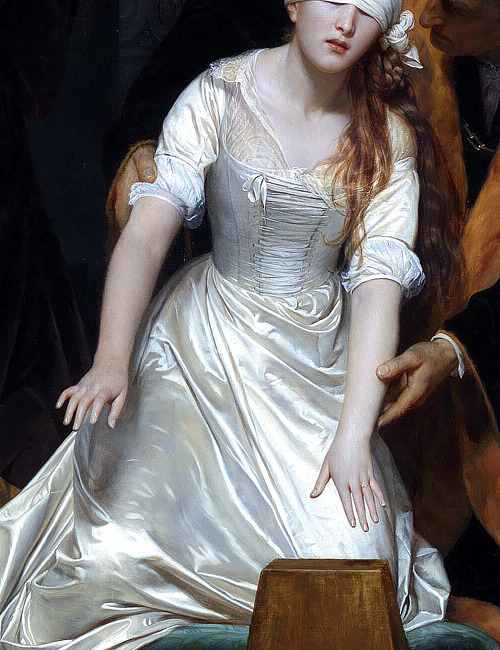
The Execution of Lady Jane Grey (detail), Paul Delaroche – 1833

Something about the moment Paul Delaroche chose to illustrate….really made this painting. Idk if that makes any sense. 

This actually happened though. When she knelt down to put her head on the block she reached out for it but couldn’t find it and panicked, yelling out “Where is it?!”. Someone kindly guided her head and shoulders to the block.

Jane was 16-17 when she died. She was put to death for sitting on a throne she never tried to grab. Her parents and in-laws together came up with a plot to keep Catholic Mary off the throne after Edward the Protestant died. She willingly gave Mary back the throne, she never wanted to be Queen.

She was put to death after a lifetime of abuse from her parents over a plot contrived by her parents. The people who were supposed to love, guide, cherish, and take care of her. Even in her time her parents abuse of her was well known and frowned upon.

Her story is so tragic.

this is the painting that got me into loving art

hazeldomain:

theclockworkzombie:

toastoat:

newwavenova:

secretlesbians:

Gustave Courbet, Le Sommeil,1866.

Le Sommeil [The Sleepers], which depicts two women entwined in a post-coital embrace, caused a stir when it was first shown in the 1870s. The police were called in, and the painting was not shown again until the 1980s. But its brief showing had an influence on a number of contemporary artists, and helped challenge the taboos associated with lesbian relationships. For modern audiences it’s a good reminder that people in the 19th century were not ignorant of lesbian relationships, as we tend to believe. And it’s pretty damn sexy, don’t you think?

They called the police on this lesbian painting.

The best part is, the lesbian embrace isn’t even the biggest thing that made the painting so controversial, it was the art style. People in the artistic community at the time were wholly familiar with sapphic relationships being portrayed in art, but were used to these scenes being portrayed in the ‘academic art’ style, which consisted of smooth, simplistic, idealised versions of the nude female form. This often went hand in hand with the depiction of Roman & Greek allegories to illustrate certain ideals (think Cabanel’s Birth of Venus). Courbet’s journey into realism was met by heavy critique from the academic movement, as the women he painted were, well, more realistic. Leaving in details such as the rolls of fat around the ribs acted as a blunt reminder to the audience that these were not euphoric goddesses caressing in ecstasy, but ordinary women having a nap together after making love. Other realist paintings suffered the same controversy, Manet’s Olympia is a perfect example, where the problem was not that the painting depicted a nude woman in an erotic pose, but the fact that she was just an ordinary courtesan, given an identity & portrayed in a place of power & control. Realism humanized the female form in art, & removed it from its previous role as a representation of the ideal.

So what disgusted people about the painting wasn’t so much that Le Sommeil depicted two women, but rather that it depicted two ‘real’ women.

Artist: So I painted a couple of lesbians in bed. 

Men: Niiiiiiiiiice

Artist: They have cellulite

Men: I AM CALLING THE POLICE

ignigeno:

The chimera I designed for our new LEGO show. I cannot express how much of a labor of love this was. It took over 100 hours just to design, let alone build and is one of the largest and most complex sculptures I’ve done.

Fun fact: This model used every single LEGO color available in standard brick.