the nice thing about horses is that you don’t have to guess their intentions because at any given time they’re figuring out how to shred our reality into pieces
but the chance of being launched headfirst into a hedge at any given moment or jumping all four legs in the air at full gallop because there’s a crack in a paving stone is part of the fun
listen: if i wanted to stake my health and sanity against the will of a creature with no more respect for human life than god himself then i’d move to mexico and become a bull rider
The Arctic Fox Research Center in Iceland put cameras in some bird colonies to see if foxes were stealing eggs/chicks
and turns out the foxes were UNJUSTLY ACCUSED
the culprits were horses
HEY THIS IS BAD
My grandfather grew up on a farm in Kansas during the Dust Bowl. He and his brother shared a horse named Patches, which they rode to school each day. Despite being poor as shit and not having quite enough to feed their animals, his family noticed that this horse looked great. His coat was unusually glossy and beautiful all of a sudden – he looked healthier than they did.
The mystery was solved when my grandfather went into the chicken coop to collect eggs, and saw Patches lifting the window cover, pushing his muzzle underneath the hens, and eating the eggs right out of their nests.
I watch the pasture horses out here eat lizards and carrion all the time. we got HOW MANY legends about flesh-eating horses, why does this surprise people?
Excuse me but I’ve heard exactly zero legends about flesh-eating horses
horse color genetic peeps what are the most ‘primitive’ colors beyond stripey dumb, are other colors significantly more or less modern?
So dun is likely the most primitive colour, and specifically bay dun at that.I’m going to be kind of technical here, because understanding colours does need a little bit of scientific explanation, but I am going to be as simple as I can be (and make some sweeping generalisations and not-strictly-accurate assertions).
Basically mammals produce two types of pigment, black, or eumelanin, and red, or phaeomelanin. In many species of mammal, primitive or wild-type colours are a combination of both types of pigment. For horses, the original colour, bay dun, is formed through the interaction of three genes, Extension, Agouti and Dun. Extension determines whether black pigment is restricted to the skin or extends into the hair; when the dominant allele E is present, black pigment extends into the animal’s coat, but when only the recessive allele e is present black pigment is limited to the skin (so in horses, homozygous recessive ee is chestnut).
Agouti regulates melanogenesis, the production of pigment, by binding to the Extension gene and limiting the expression of black pigment. In many mammals it does this in bands in the individual hair shafts, but in horses Agouti works by limiting the expression of black pigment to specific regions of the body – the legs, the mane, the tail, etc. So when the dominant allele A is present, you get a bay horse, but if only the recessive allele a is present, then Extension has full rein, and black pigment extends throughout the horse’s body. In other words, you get a black horse.
As for Dun, it works by concentrating pigment in the central part of the hair shaft, and leaving the sides transparent, hence the paler, diluted appearance of the bodies of duns. Interestingly, Dun is responsible for the striping of zebras, hemiones and asses, as well as horses.
So, with these three genes, Extension, Agouti and Dun, interacting to create the original wild-type colour, what were early mutations? Well, samples from a pre-domestic horse that lived about 43 000 years ago indicated the presence of a mutation in TBX3, known as non-dun1 (d1). Horses homozygous for d1 have more intense pigmentation than horses with D, since the pigment is spread more widely through the hair shaft, but they also have primitive markings. Samples from a wild horse post-domestication (c. 2400 B.C., so Bronze Age) show the presence of a second non-dun mutation (d2), which permits uniform distribution of pigment through the hair shaft, resulting in intense pigmentation. Horses homozygous for d2 also lack primitive markings. So d2 is the most widely-spread allele in modern domestic horse populations, but it is still quite old. What the presence of d1 and d2 in ancient populations means, of course, is that plain bay is a very old colour. (See Imsland et al. 2016.)
Black seems to have been an early mutation at the agouti locus. Ludwig et al. 2009 examined equine remains from the Late Pleistocene and Early Holocene (c. 8000 B.C., end of the Ice Age), and found that not only did Early Holocene Iberian horses have the mutation a at the Agouti locus, but of the eight fossil horses sampled, half of them were black. While Pleistocene remains in Siberia and Central and Eastern Europe were purely bay/bay dun, by c. 4500 B.C., 25% of the horses in this area were black as well, possibly because of increased forest cover springing up as the glaciers retreated, possibly because the gene had spread from migrating Iberian horses.
The chestnut allele e is first identified in the remains of a Romanian horse c. 4300 B.C., but the first chestnut horses are found almost two thousand years later in Siberia. By the Bronze Age, chestnuts made up roughly a quarter of the equine population. White-spotting mutations also are dated to this time, with sabino (presumably Sb1) appearing first (c. 2000 B.C.), and tobiano around 1500-1000 B.C.. Cream (and thus palomino, buckskin and smoky black) makes an appearance in Siberia c. 800 B.C., as does silver dapple. The Yukon Horse, Equus lambei, may have exhibited a bay silver phenotype, based on the mummified remains of a 26 000 year old carcass, with a blonde mane and tail and lower legs that were darker than its upper body, but I don’t think anyone has done a genetic test on the remains.
Figure 1 from Ludwig et al. 2009, showing the development of coat colours (or at least their earliest attested appearances in equine remains).
Whilst the explosion of colours and markings in horses took place around the time of domestication, there was, however, a surprising amount of variety in pre-domestic coat colours. Pruvost et al. 2011 found the LP allele, which is associated with appaloosa leopard spotting patterns, in the remains of six horses, four from the Pleistocene, and two from the Holocene. Since homozygous LP co-occurs with night blindness, homozygous LP would be a disadvantage for a pre-domesticated horse; all six of the ancient horses tested were heterozygous for LP, and thus leopard-spotted appaloosas. Which rather satisfyingly proved that the spotted horses on the walls at Pech-Merle were realistic representations of the colours found in Ice Age horses.
If we’re going off artistic representations, plus the evidence of the Przewalski’s Horse and the asses and onager, pangaré would almost certainly have been present in these ancient populations, but I’m not certain that we have a test for it yet. Pangaré may also be responsible for the ‘wild bay’ colouring, which has reduced black points, but no test, no idea.
As for grey, I don’t think any ancient horse remains so far tested have been grey, or perhaps it would be more accurate to say that they have not necessarily been tested for grey, as grey is a mutation that acts on the ‘base’ colour of the horse. However, the presence of grey in breeds as distantly-related to each other as the Arabian and the Icelandic suggest that it is likely to be several thousand years old. (See Rosengren Pielberg et al. 2008.)
Worth bearing in mind as well is the fact that white spotting was probably around from early times, as mutations at the KIT locus seem to occur relatively frequently – there are (by my last count) twenty different white spotting patterns that have been identified, and there are definitely many more that have yet to be identified. It’s just a matter of whether white-spotted horses were easy prey, and whether, once the horse was domesticated, people liked their pintos or not. (See Wutke et al. 2016 on the popularity of white spotting.)
Anyway, DNA evidence so far indicates that early colours of the horse were bay dun and grullo, bay, black, leopard appaloosa, and a handful of chestnuts, possibly some greys; pangaré certainly existed in the population as well, and may even have been prevalent.
I also recommend the Equine Tapestry as a good resource for easy reading on equine coat colour genetics, though sadly the blog has not been active since April 2016.
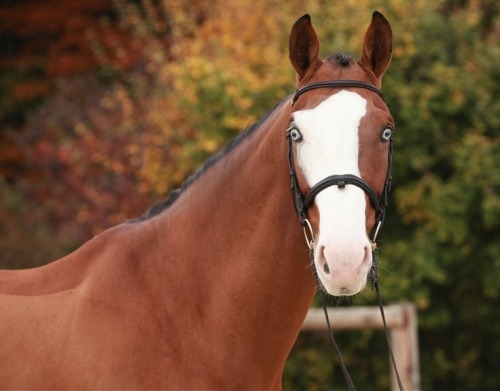
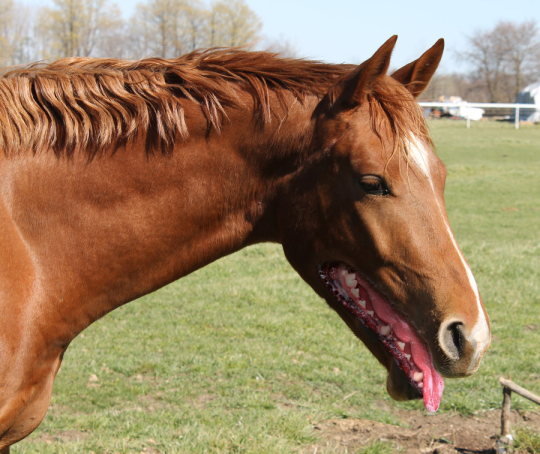
can someone please edit a horse to make it look less horrible
i have stared at this…. thing, this fucking DEMON for like 10 solid minutes trying to come up with some single phrase to describe fucking awful this is, and i just can’t. this is easily – EASILY – the worst thing i’ve ever seen in my life, and that includes the brain surgery i observed when i was in college. everyone on this site fuckin goes on and on about “cursed images” but i seriously feel like this fucking land shark is going to reach out of my computer and eat my face. if i saw a pack of these running towards me down a hill, i would do everything in my power to kill myself before they reached me. i would rather be eaten alive by rats then ever see this again. this is truly, genuinely horrible on both a physical & emotional level. all of this doesn’t even begin to cover how much i hate this fucking thing. this fucking hellhound. this goddamn long-mouthed…… fucking… fuck it. i’m not finishing this. i need to stop looking at this. fuck you




 Site Title