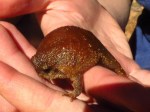
A little rain frog [possibly Breviceps montanus, the Cape Mountain rain frog] found and photographed by Lize Joubert-van der Merwe. I especially like the caption that was posted with these images:
“A perfectly round shape spotted in the footpath… It appeared more like a mushroom than a frog at a first glance. Next to a river. Fynbos not burned recently. Facial expression – grumpy. Not a happy camper. No jumping. Only crawling. It only sat quietly in the darkness of one of the hikers’ hands (in the darkness). The frog was treated with respect, and nobody had sunblock on their hands – no damage to the frog’s skin.”
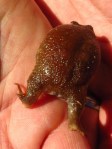
These are the kind of snouts legends are made of- the profound protrusions of the duck-bill hylid frog [also known as the Mexican shovel-headed tree frog; Diaglena spatulata; synonymous with
Triprion spatulatus]. So what are their “bills” used for? The verdict’s still out, but it these frogs have been sighted on multiple occasions backing into holes in trees to hide, and using their heads to “plug” the entrance and conceal themselves- proving useful in this application at least. These frogs can be found from the Pacific coast of Mexico to the Isthmus of Tehuantepec, Oaxaca. They’re listed as “least concern” on the IUCN Red List. Images by Jorge Armín Escalante Pasos and Cheryl Harleston of iNaturalist.org.







 Site Title