every painting by Andrew Wyeth is of a ghost and you can’t convince me otherwise
there are so many fucking ghosts in this picture I can’t even count them
Andrew Wyeth’s father was famous artist NC Wyeth, who was killed by a train in 1945. The tragedy had a profound effect on Andrew’s art, and everything that came after, including Christina’s World (his most famous) took on a haunted, romantic quality.
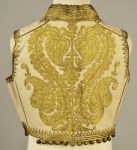
it’s hilarious to me when people call historical fashions that men hated oppressive
like in BuzzFeed’s Women Wear Hoop Skirts For A Day While Being Exaggeratedly Bad At Doing Everything In Them video, one woman comments that she’s being “oppressed by the patriarchy.” if you’ve read anything Victorian man ever said about hoop skirts, you know that’s pretty much the exact opposite of the truth
thing is, hoop skirts evolved as liberating garment for women. before them, to achieve roughly conical skirt fullness, they had to wear many layers of petticoats (some stiffened with horsehair braid or other kinds of cord). the cage crinoline made their outfits instantly lighter and easier to move in
it also enabled skirts to get waaaaay bigger. and, as you see in the late 1860s, 1870s, and mid-late 1880s, to take on even less natural shapes. we jokingly call bustles fake butts, but trust me- nobody saw them that way. it was just skirts doing weird, exciting Skirt Things that women had tons of fun with
men, obviously, loathed the whole affair
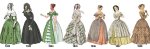
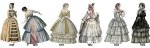
(1864)
(1850s. gods, if only crinolines were huge enough to keep men from getting too close)
(no date given, but also, this is 100% impossible)
(also undated, but the ruffles make me think 1850s)
it was also something that women of all social classes- maids and society ladies, enslaved women and free women of color -all wore at one point or another. interesting bit of unexpected equalization there
and when bustles came in, guess what? men hated those, too
(1880s)
(probably also 1880s? the ladies are being compared to beetles and snails. in case that was unclear)
(1870s, I think? the bustle itself looks early 1870s but the tight fit of the actual gown looks later)
hoops and bustles weren’t tools of the patriarchy. they were items 1 and 2 on the 19th century’s “Fashion Trends Women Love That Men Hate” lists, with bonus built-in personal space enforcement
Gonna add something as someone who’s worn a lot of period stuff for theatre:
The reason you suck at doing things in a hoop skirt is because you’re not used to doing things in a hoop skirt.
The first time I got in a Colonial-aristocracy dress I felt like I couldn’t breathe. The construction didn’t actually allow me to raise my arms all the way over my head (yes, that’s period-accurate). We had one dresser to every two women, because the only things we could put on ourselves were our tights, shifts, and first crinoline. Someone else had to lace our corsets, slip on our extra crinolines, hold our arms to balance us while a second person actually put the dresses on us like we were dolls, and do up our shoes–which we could not put on ourselves because we needed to be able to balance when the dress went on. My entire costume was almost 40 pounds (I should mention here that many of the dresses were made entirely of upholstery fabric), and I actually did not have the biggest dress in the show.
We wore our costumes for two weeks of rehearsal, which is quite a lot in university theatre. The first night we were all in dress, most of the ladies went propless because we were holding up our skirts to try and get a feel for both balance and where our feet were in comparison to where it looked like they should be. I actually fell off the stage.
By opening night? We were square-dancing in the damn things. We had one scene where our leading man needed to whistle, but he didn’t know how and I was the only one in the cast loud enough to be heard whistling from under the stage, so I was also commando-crawling underneath him at full speed trying to match his stage position–while still in the dress. And petticoats. And corset. Someone took my shoes off for that scene so I could use my toes to propel myself and I laid on a sheet so I wouldn’t get the dress dirty, but that was it–I was going full Solid Snake in a space about 18″ high, wearing a dress that covered me from collarbones to floor and weighed as much as a five-year-old child. And it worked beautifully.
These women knew how to wear these clothes. It’s a lot less “restrictive” when it’s old hat.
I have worn hoop skirts a lot, especially in summer. I still wear hoop skirts if I’m going to be at an event where I will probably be under stage lights. (For example, Vampire Ball.)
I can ride public transportation while wearing them. I can take a taxi while wearing them. I can go on rides at Disneyland while wearing them. Because I’ve practiced wearing them and twisting the rigid-but-flexible skirt bones so I can sit on them and not buffet other people with my skirts.
Hoop skirts are awesome.
Hoop skirts are also air conditioning. If you ever go to reenactments in the South, particularly in summer, you’ll notice a lot of ladies gently swaying in their big 1860s skirts – because it fans all the sweaty bits. You’ll be much cooler in a polished cotton gown with full sleeves, ruffles, and hoopskirt than in a riding jacket and trousers, let me promise you! (This is part of the reason many enslaved women also enthusiastically preferred larger skirts – they had more to do than sit in the shade, but they’d get a bit of a breeze from the hoops’ movement as they were walking.)
They’re also – and I can’t emphasize enough how important this is – really easy to pee in. If you’re in split-crotch drawers (which, until at least the 1890s, you were), you can take an easy promenade a few feet away from the gents and then squat down and pee in pretty much total privacy. It gives so much freedom in travel when it’s not a problem to pee most anywhere.
People also don’t realize that corsets themselves were a HUGE HUGE IMPROVEMENT over previous support-garment styles – and if you have large breasts that don’t naturally float freely above your ribcage (which some people’s do! but it’s not that common), corsets are often an improvement over modern bras.
They hold up the breasts from underneath, taking the weight of them off your back. Most historical corset styles don’t have shoulder straps, so you’re not bearing the weight of your breast there, either, and you can raise your arms as far as your dress’s shoulder line allows (which is the actually restrictive bit – in my 1830s dress, literally all I can do is work in my lap, but in my 1890s dress I can paddle a kayak or draw a longbow with no trouble. Both in a full corset). They support your back and reduce the physical effort it takes to not slouch, helping avoid back pain. They’re rigid enough that you don’t usually have to adjust your clothing to keep it where it belongs. They’re flexible – if you’re having a bloaty PMS day you just … don’t lace it as tightly, and if your back muscles are sore you can lace it a little tighter. And you can undo a cup (or, y’know, not have breast cups) to nurse a baby without losing any of the structural integrity of the garment.
I do educational/historical dressing and people are really insistent, like, “The corset was invented by a man, wasn’t it?” “Actually, women were at the forefront of changing undergarment styles throughout the 19th century!” “But it’s true that it was invented by a man.”
Uh, well, it’s hard to say who “invented” the style but it’s very likely that women’s dressmakers mostly innovated women’s corsets and men’s tailors mostly innovated men’s corsets, honey. Because those exist too.
Also? These fashions are about taking up space. They’re about being loud and visible and saying HERE I AM. About saying “I’m so rich, I need someone to help me dress every morning.” And about saying, “I am not solely here for male consumption”–there’s a reason so many cartoons lampooning women’s fashion are about how hard those ladies are to kiss, and how impossible it’d be to have a quick fuck in them. (Which it actually isn’t, but that’s beside the point)
Historical women’s fashions aren’t 100% unproblematic and absolutely wonderful. They make stark class distinctions incredibly visible, because you simply cannot wear some of these dresses and keep them maintained without a private staff to do a ton of work for you. They upheld a standard of femininity a lot of women were excluded from. They limited women’s and girls’ participation in sports and athletics.
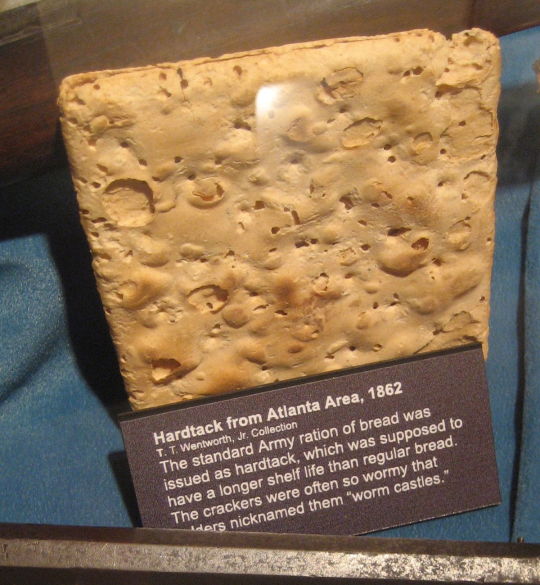
an edible cracker with just one side. mathematically impossible and yet here I am monching on it.
‘scuit’ comes from the french word for ‘bake’, ‘cuire’ as bastardized by adoption by the brittish and a few hundred years
‘biscuit’ meant ‘twice-baked’, originally meaning items like hardtack which were double baked to dry them as a preservative measure long before things like sugar and butter were introduced. if you see a historical doccument use the word ‘biscuit’ do not be fooled to think ‘being a pirate mustve been pretty cool, they ate nothing but cookies’ – they were made of misery to last long enough to be used in museum displays or as paving stones
‘triscuit’ is toasted after the normal biscuit process, thrice baked
thus the monoscuit is a cookie thats soft and chewy because it was only baked once, not twice
behold the monoscuit/scuit
Why is this called a biscuit:
when brittish colonists settled in the americas they no longer had to preserve biscuits for storage or sea voyages so instead baked them once and left them soft, often with buttermilk or whey to convert cheap staples/byproducts into filling items to bulk out the meal to make a small amount of greasy meat feed a whole family. considering hardtack biscuits were typically eaten by dipping them in grease or gravy untill they became soft enough to eat without breaking a tooth this was a pretty short leap of ‘just dont make them rock hard if im not baking for the army’ but didnt drop the name because its been used for centuries and people forgot its french for ‘twice baked’ back in the tudor era, biscuit was just a lump of cooked dough that wasnt leavened bread as far as they cared
thus the buttermilk biscuit and the hardtack biscuit existed at the same time. ‘cookies’ then came to america via german and dutch immigrants as tiny cakes made with butter, sugar/molasses, and eggs before ‘tea biscuits’ as england knew them due to the new availability of cheap sugar- which is why ‘biscuit’ and ‘cookie’ are separate items in america but the same item in the UK
the evolution of the biscuit has forks on its family tree
I love it when a shitpost turns into an actually interesting post.
Thousands of years ago, somebody looked at a flock of sheep and went, “well, they aren’t cold.”
Guys. Guys.
It’s so much better than that.
So once upon a time, goats and sheep were essentially the same animal, and all of them had hair. Now, you can do some stuff with hair, but you can’t do a lot, so mostly sheep/goats were kept for meat and milk.
Except then a mutation showed up, and some of the sheep/goats had WOOL instead. And someone realized that 1. you could spin that shit, and 2. then you could WEAVE that shit, and 3. IT GREW BACK.
Generations of selective breeding ensued. Two visibly discrete species emerged, one primarily for meat and milk, and the other primarily for wool. They also have different behavioural characteristics, because independence was not helpful in a sheep, so it was bred out of them. Sheep remain one of the few non-draft animals that we farm even though they are not delicious.
The most similar part of sheep and goats that remains today is their skeleton. On an archaeological dig, you find THOUSANDS of bones and bone fragments that can only be identified as “sheep/goat”. It’s incredibly frustrating, but also kind of hilarious after you’ve spent enough time in the sun.
ANYWAY, human beings have always been smart and surprisingly good at changing nature because they want a sweater.
The entire knitting community needs to hear this.
Oh man I’m so glad I can add this to my arsenal of responses to people who say all GMOs are made of poison.
In zooarchaeology, sheep/goat is a valid category and no one will press you further on the issue.
Huh, I wonder if this is part of why Chinese only has one word for sheep/goat (羊). You can distinguish as 绵羊 “wool-sheepgoat” for sheep vs 山羊 “mountain-sheepgoat” for goat.
Preserved within a small tin canister, the cream was discovered during excavations by Pre-Construct Archaeology of a Roman temple precinct on Tabard Street, Southwark in 2003. The main constituent of the cream was animal fat mixed with starch and tin oxide.
It’s kind of fucked up when you realize the image of the quaint 1950s leave it to beaver family with the housewife and hard working husband is a propaganda model that had to be adopted to justify stripping women of their jobs they were able to get during WWII. Like women literally proved they could keep an industria wartime economy afloat without men and society had to craft some serious insidious shit to get them back into the home.
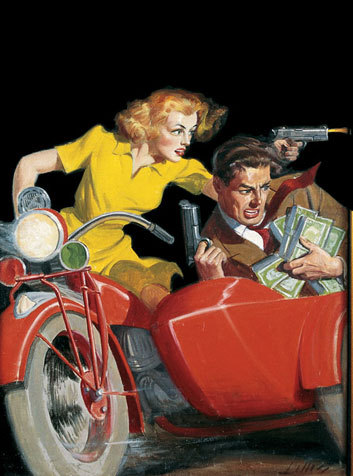
This painting for the cover of the pulp Private Detective Magazine by Richard Lillis was published in early 1945, before the war was over. I’ve long wondered whether this painting could not have been published even six months later, because the gender roles of the people in this painting show a strong woman in charge (firing a gun, driving) while the man is in the weaker role of passenger and the one holding the bag.
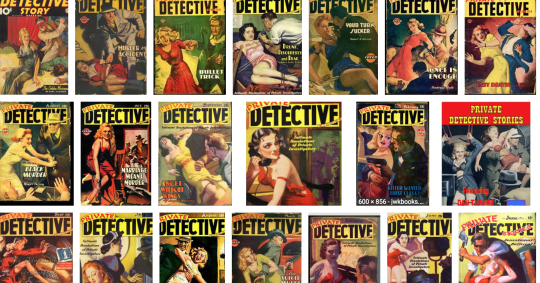
But get a load of this screenshot of Private Detective Magazine covers when the search term includes 1946…
Lots of damsels in distress, huh? I’m no history major, but a quick Google search really makes a big impression.
When we say representation is important, it really IS important. It can change the way a culture sees gender roles in just the space of a few years.
Keep pushing media to represent you, and demand it be positive representation: women, PoC, LGBTQIA+, disabled people. Minds can be changed in a really short amount of time, when they’re exposed to people different from themselves.
With infinite pleasure, because St. Olga of Kiev is one of the most magnificent bitches in history and a personal idol of mine. I named a hive of bees after her.
Olga was the daughter of Oleg Veshchy, the founder of the Kievan Rus state. She was married to Prince Igor, the son of Prince Rurik of Novgorod. (A founder of the Rurik dynasty of Tsars.)
From all accounts, they seemed quite happy together. They had a son, and everything seemed good.
When Oleg died, Igor became the ruler of the Kievan Rus. As the ruler, he undertook one of the standard duties of the ruler, namely, going around to the local Slavic tribes and collecting tribute (basically, early taxes) from them.
One tribe, the Drevlyans, did Not Like It when he demanded more tribute than they were accustomed to paying, and summarily killed him on the spot. There was much laughing and carousing over this, not knowing that Olga, at the news of her husband’s death, had entered Ice Queen Ultimate Revenge Mode and would only be appeased by the blood of those who had killed her husband. She had the full support of the Kievan Rus army, who knew a queen of steel and fire when they saw one, and the deep respect of the Kievan Rus people, who also knew that the Drevlyans Done Fucked Up.
The Drevlyan tribe then compounded their mistakes. Assuming that a young widow with a three year old son would be a weak and easy target, they sent envoys to her court to attempt to pressure her into marrying the Drevlyan prince, Mal.
This was a huuuuge fuckin mistake oh my gods.
Olga greeted them graciously, all smiles and good manners. She told the messengers that as a measure of esteem, her people would carry their boats from the river directly to her palace. The messenger bought it, and sure enough Olga’s people showed up, picked up the boats, carried them inland…and then threw them into hugeass pits dug for just this purpose and buried those fuckers alive.
But she was not done.
Olga sent word to the Drevlyans that she accepted their offer, and that she was still hosting their messengers, nope, don’t worry that they haven’t come back, haha, they’re just partying, you should send some more important envoys to help figure out wedding logistics.
They did.
When they arrived, she invited them into a bathhouse to freshen up after her trip. And then, once they were all inside, she bolted the doors from the outside and burned it to the ground.
After that, she sent a message to the Drevlyans saying oh yep I am super about getting married, I’m going to come and let’s have a lavish feast in the memory of my dead husband first. The Drevlyans thought this was a splendid idea.
So she shows up, bringing extra booze, and the Drevlyan court gets absolutely hammered. Olga then stands up, and as cold as steel in a Siberian December orders her men, who’d not been indulging, to kill the lot.
And they did. All five thousand of them.
Olga went home. The Drevlyans, having mostly got the message, meekly paid her tribute as their ruler from then on.
Save for the town of Iskorosten, who were, apparently, still nursing a grudge. “Fuck you,” they said. “You’re getting nothing.”
Olga smiled, which should have been a warning sign right there. “Fine.” She said, sweetly. “Then all I ask is a dove from each home.” (Pigeons and doves, keep in mind, were commonly kept for eggs, meat, and manure, and will always return to their roost.)
Iskorosten thought this was reasonable, and did so.
So Olga had a piece of burning paper tied to each dove and released. They flew back to their dovecotes in the city, which burned to the ground.
Olga ruled as regent for her son until he matured, and then ruled at home for him when he was off on his (frequent) military campaigns. He felt safe in going on these, mind, because he knew his mom had shit at home on lockdown. They were a great team, TBH.
She converted to Christianity and was baptized in Constantinople sometime around 955 to 957. Her efforts to spread it gained her sainthood.
this map is fascinating for a variety of reasons but the particular part of it that made me fall down a wikihole was the Cucuteni–Trypillian culture, which I was not familiar with. they seem pretty cool for a variety of reasons but what caught my eye is that they’d build a city, literally the largest city in the world they would build, and then they’d live there for about sixty years, and then they’d burn the fucker down. Why? Nobody knows. They’d move somewhere else and do the whole thing over, and then maybe move back and rebuild the first city identically on the same foundations. In one place they did that thirteen times.
this is some SCP type shit. what was chasing them. what happened in these cities that they needed burning down over and over
…what
right????? also i forgot my favorite part: we can’t get buildings to burn down this way. we’ve tried, nobody has actually managed to set a fire that leaves the same kind of rubble. it is not…traditional…fire













 Site Title